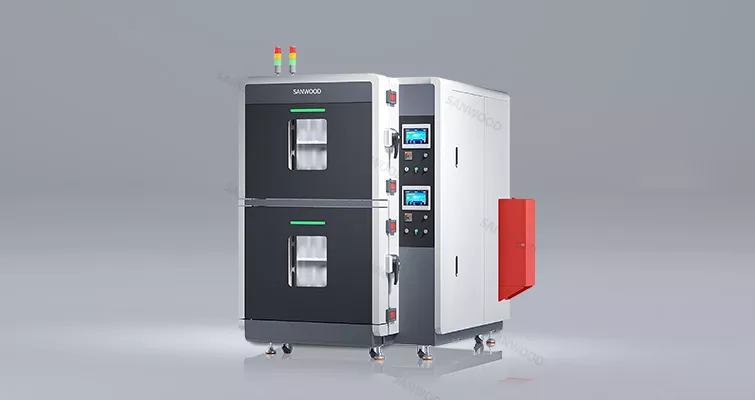
Double-layer Battery Test Chamber
The Sanwood Double-Layer Battery Test Chamber is an advanced, high-throughput solution engineered for high-volume battery testing. Featuring two independent test zones within a single footprint, it allows for simultaneous yet separate environmental and charge-discharge testing on different samples or under different conditions. This dual-layer architecture effectively doubles your testing capacity and lab space utilization, making it ideal for parallel R&D projects, production line sampling, and accelerated lifecycle testing.
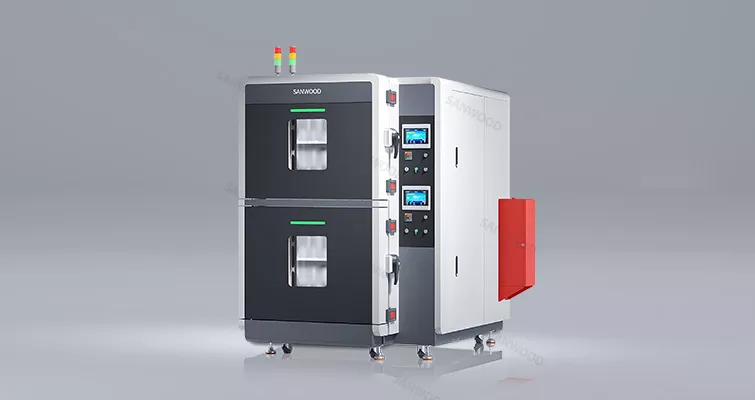
Double-layer Battery Explosion-proof Test Chamber
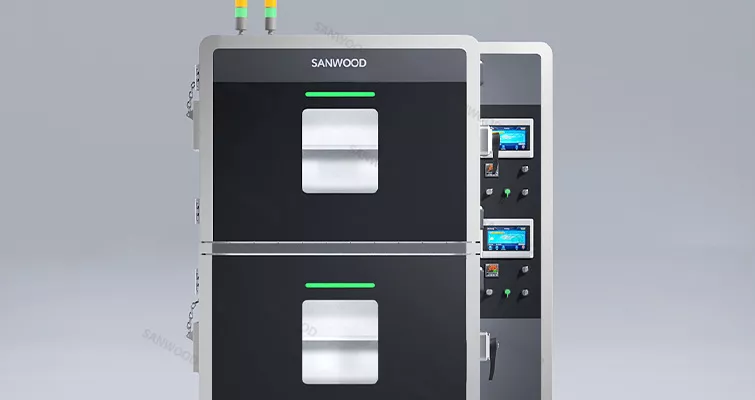
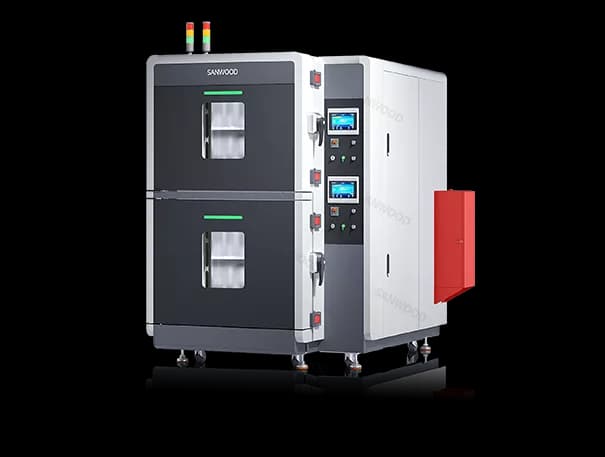
The double-layer battery test chamber is equivalent to two battery explosion-proof test chambers, but its floor space is only the area of a test chamber.
Advantages Of Sanwood Test Chamber
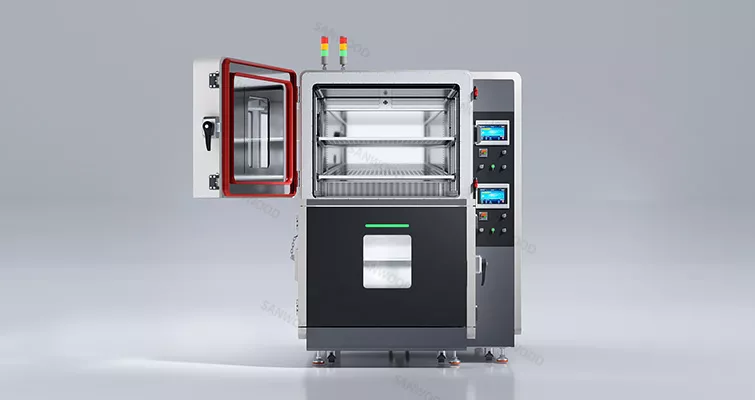
The double-layer battery explosion-proof test chamber adopts a superimposed double-layer design structure and has two independent control systems,compared with the general battery explosion-proof test chamber.
- •Two independent control layers can simultaneously run different test programs, doubling testing capacity within the same footprint.
- •Each level is equipped with an independent temperature control system and test channel, ensuring complete environmental and data isolation between upper and lower levels.
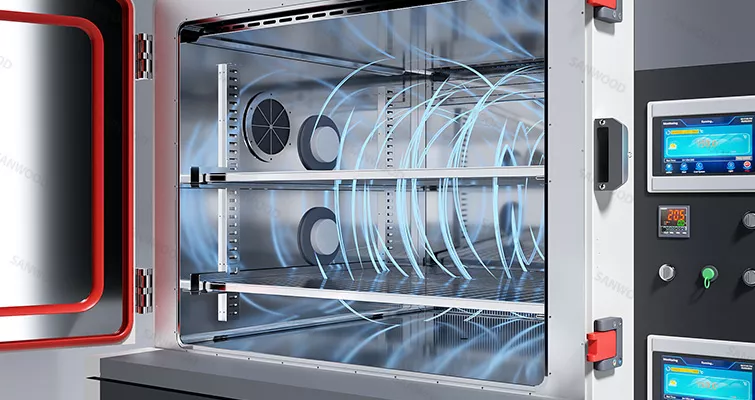
- •The equipment has balanced and stable heating and humidification performance.
- •Equipment manufacturing complies with UL, IEC, SAE, and GB/T testing standards.
- •The test chamber complies with the best safety test for EUCAR hazard levels (0-7).
Application Fields Of Double-layer Test Chamber
Double-layer battery explosion-proof test chambers are mainly used to perform safety tests on batteries (especially lithium-ion batteries) to evaluate their performance and safety under extreme conditions. These test chambers can simulate various situations that may cause battery explosion or fire, including overcharging, short circuit, high temperature, high voltage, etc. as follows:
- •Battery temperature cycling performance: The battery explosion-proof test chamber simulates a temperature cycling environment to test the adaptability and stability of the battery under conditions of rapid temperature changes.
- •Battery high and low temperature testing: The battery explosion-proof test chamber can simulate high and low temperature environments to test the battery's high and low temperature resistance under these conditions.
- •Other extreme environment tests: The battery explosion-proof test chamber can simulate extreme environmental conditions such as high voltage and low voltage to comprehensively evaluate the stability and reliability of the battery.
The Test Standards Of Battery Test Chamber
double-layer battery explosion-proof test chamber should be able to perform reliability tests on batteries, such as cycle life tests, storage life tests, etc. These tests can evaluate the reliability of batteries under different usage conditions to determine the service life and safety of the batteries. There are testing standards for each aspect of the battery , such as:
- •UN/DOT 38.3: United Nations lithium battery testing requirements, which stipulates the safety testing standards for lithium batteries during transportation.
- •IEC 62660-2: Reliability and abuse testing of lithium-ion batteries for electric vehicles. Covers capacity discharge test, high temperature endurance test, temperature cycle test, etc.
- •SAE J2464: Guidelines for safety and abuse testing of rechargeable energy storage systems for EV and HEV. Including thermal stability testing and temperature cycling testing, etc.
- •IEC 62233: Electrical safety in the workplace - Explosion protected equipment.This standard specifies the requirements for explosion-protected equipment, including batteries, in hazardous areas. The three-layer battery explosion-proof test chamber also complies with testing standards such as EN 60079, IEC 62233,SAE J2464, SAE J2929,IEC 62133,IEC 60086-4, etc
Control System Of The Test Chamber
The control system of the Sanwood test chamber adopts the world's leading software and hardware system to ensure that the test chamber operates under preset conditions, provide accurate and reliable experimental data, and help users achieve precise control and data collection of various experimental conditions.
- •Controller: It adopts the controller imported from South Korea Sanwon and the self-developed control system, which can be equipped with Siemens control system and equipped with RS232, RS485 and Ethernet communication ports.
- •Programmable control: It supports setting experimental programs, such as heating, cooling, constant temperature time, etc., and can execute multiple program settings, and supports advance reservation startup function.
- •Multiple languages optional: English, Korean, Russian, Chinese and Japanese.
- •Remote monitoring: Using network remote technology to achieve remote control, the test chamber can be monitored at any time, and the current data can be viewed through the user's PC and mobile phone, which improves the convenience of testing. The specific control system of the test chamber will vary depending on the model. Please read the "Sanwood Environmental Test Chamber Manual" carefully before use and comply with the safety operating procedures.
Refrigeration System Of The Test Chamber
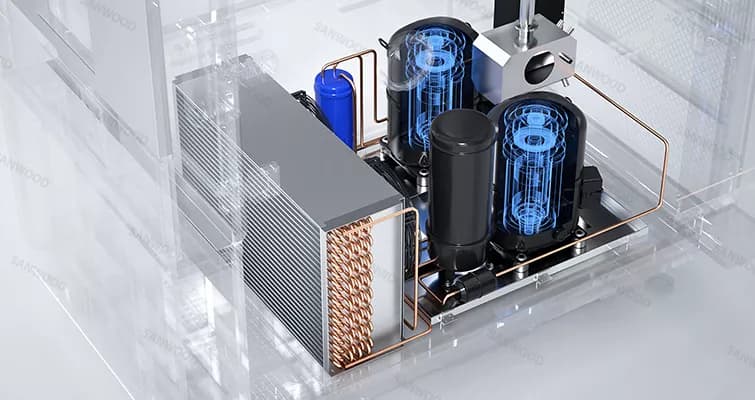
The refrigeration system of the test chamber is a complex and important system. The stability of the refrigeration system is crucial to the accuracy and reliability of the test results.
- •Sanwood Technology has developed a refrigerant hot gas defrosting technology, which effectively melts the frost on the evaporator by injecting high-temperature and high-pressure refrigerant steam into the heat exchanger in the test chamber. This not only ensures that the evaporator does not frost, but also greatly reduces the energy consumption of the equipment.
- •The refrigeration unit adopts an internationally renowned brand.
- •Optimize the layout of the refrigeration system, and adopt VRF (refrigerant flow control) technology based on the PID cold end output principle to achieve low-temperature energy-saving operation, which can reduce energy consumption by 30% under low-temperature conditions.
- •The refrigeration system adopts a modular design, with low failure rate, few welding points, high refrigeration efficiency, good reliability, simple maintenance, and low maintenance cost.